
Both tools sit on the same shortlist for a reason. Both promise to turn customer signals into action across 2, 12, or 40 locations. Both will quote you a price by Thursday. They are not, however, the same product.
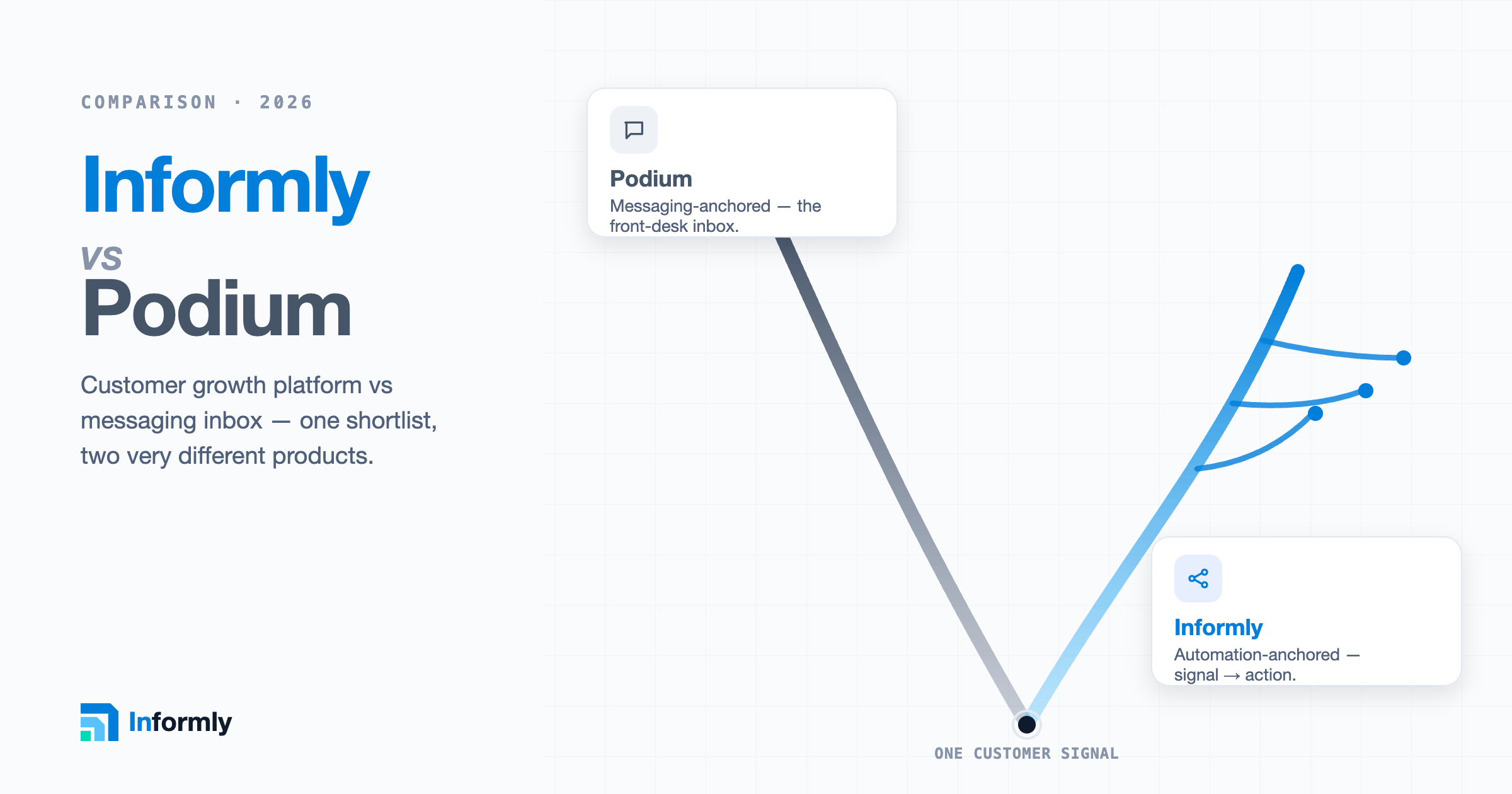
Podium is messaging-anchored. Informly is automation-anchored. That single sentence is the buying decision in disguise, and it's what most comparison pages miss.
This piece is for the operator who has both quoted, both demoed, and a Slack DM open with the head office asking which one to pick. No takedown. No hype. The verdict depends on the kind of pain you're solving, and we'll name three buying scenarios where the answer flips.
The 30-second answer
Choose Podium if your team's daily work is inbound conversations: guests texting the host stand, members DMing the front desk, customers asking about hours. Podium's threaded inbox is the best in the category.
Choose Informly if your daily work is signals. Survey responses, visits, redemptions, reviews that need to automatically fire a ticket, a coupon, a referral ask, or a loyalty stamp. Informly is one customer record, one automation engine, seven connected modules.
Some operators run both: Podium for the inbox, Informly for everything that happens after a signal. The pricing section covers when that combination breaks even.
Why each product exists
Podium: the front-desk inbox
Podium started in 2014 as a review-collection tool for local businesses. Today its homepage cites 60,000+ businesses (the older 100,000+ figure still circulates on third-party profiles like Sacra), with deep automotive-vertical integrations (CDK, VinSolutions, DealerSocket). The center of the product is the inbox: a customer texts, replies arrive in one app, the front-desk staffer answers. Around that core, Podium added webchat, VoIP phones in 2023, payments, and AI Employee for automated review replies. It's a sales-led, annual-contract motion. Onboarding gets you a dedicated manager for 2 to 4 weeks, then a handoff to a CSM.
Informly: the customer growth platform
Informly launched in 2025 with a different bet. Seven modules (Surveys, Loyalty, Coupons, Referrals, Testimonials, Contacts, Ticketing) share one Contact record. An automation engine connects 5 triggers to 11 actions (browse the pre-built workflow library), so a survey response can fire a ticket, a coupon, a referral ask, and a loyalty stamp from the same event. The bet rests on a hard number: 68% of customers leave because they feel unappreciated, not because of price (Customer Thermometer, citing John Gattorna, 2008). Acting on feedback is where retention lives. Asking and not acting is theater.
The pivot: messaging-anchored vs automation-anchored
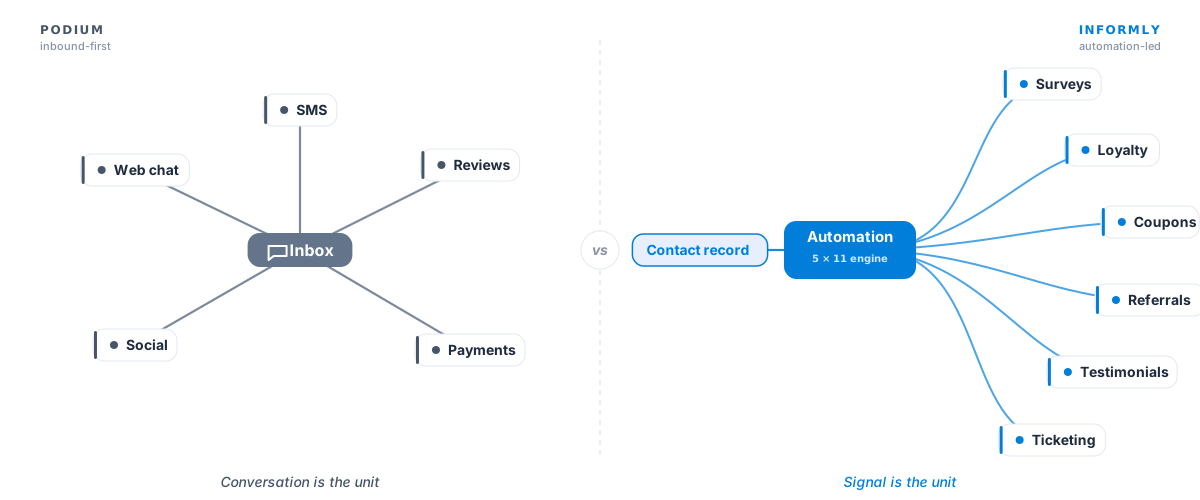
Podium's architecture starts at the inbox and radiates outward. Reviews, payments, and AI replies all attach to the conversation. That's a coherent product, and a strong one for a front-desk team whose main job is replying to live customer messages within five minutes.
Informly's architecture starts at the Contact record and radiates outward. Every survey response, every visit, every coupon redemption, every referral conversion writes to the same record. The automation engine then routes any of five trigger types (onContactCreate, onCouponRedeem, onSurveyResponse, onTestimonialSubmit, onTicketCreate) into any of eleven action types (createTicket, rewardCoupon, createReferrer, sendSurvey, testimonialRequest, email, webhook, and others). The signal is the unit. The action is automatic.
Why does this matter? Because 96% of unhappy customers never complain. They simply leave (Esteban Kolsky / ThinkJar consumer survey, via Provide Support). Inbound messaging tools, by definition, only see the 4% who reach out. The other 96% show up as a low survey score, a missed appointment, a dropped second purchase. If your CX strategy depends on those signals being routed to a human or a coupon or a recovery offer (automatically, within hours), you need an automation layer, not an inbox.
If your CX strategy is "answer faster when they message us," Podium's the better-shaped product.
Side-by-side: how Informly and Podium compare
The Informly vs Podium decision usually comes down to job-fit, not feature count. A feature matrix without a thesis is a feature dump. So read the table below with the pivot in mind. Podium owns the inbox column. Informly owns the modules-and-automation columns. Where Podium has a check and Informly doesn't, that's a real gap. Where Informly has a check and Podium doesn't, same.
| Capability | Podium | Informly |
|---|---|---|
| Unified inbox (SMS, GBP, FB, IG, webchat) | ✓ | Partial (via integrations) |
| Webchat / chat-to-text | ✓ | – |
| VoIP / business phones | ✓ | – |
| Review collection + response | ✓ | ✓ (Google, Yelp, Trustpilot, TripAdvisor, G2) |
| Reviews AI auto-reply | ✓ ($99/mo add-on) | Partial (basic auto-tagging shipped) |
| Native surveys (NPS, CSAT, branching) | Partial (NPS/CSAT only) | ✓ |
| Loyalty (Apple Wallet / Google Wallet native) | – | ✓ |
| Coupons + automated win-back | – | ✓ |
| Referrals (automated ask + tracking) | – | ✓ |
| Testimonials (collect + embed) | – | ✓ |
| Ticketing (auto-create from feedback) | – (inbox assignment only) | ✓ |
| Cross-module automation engine | ✓ (Branching Automations, Oct 2025) | ✓ (5 triggers × 11 actions) |
| Multi-location reporting | ✓ (Signature tier only) | ✓ (all plans) |
| Native integrations (restaurants/salons) | Light (Zapier-mediated) | Native Shopify, WooCommerce, Apple/Google Wallet |
| Pricing model | Sales-led, $399 to $999+/mo, annual | Self-serve, Free + $39/mo per location |
| Time-to-value | 2 to 4 weeks with onboarding manager | Under five minutes self-serve |
Read it honestly. Podium genuinely wins on five rows: webchat, VoIP, the unified messaging inbox, AI reply maturity, and brand recognition. Informly wins on Loyalty, Referrals, Coupons, Testimonials, full Surveys, native Ticketing, and pricing model. The right question isn't "which has more checks." It's "which job do you actually need done first?"
Pricing: what each actually costs
Podium doesn't publish pricing on its site. The numbers below come from third-party 2025-2026 breakdowns and G2 reviews. The headline tiers are Core at $399/month (up to 2 locations, 1 to 4 users, 250 SMS), Pro at $599/month (up to 5 locations, unlimited users, 500 SMS), and Signature starting around $999+/month (unlimited locations, custom SMS, required for the multi-location switcher). Annual contract is required at every tier (RepliFast, 2026, Quo).
Then come the add-ons. AI Employee for automated review replies runs ~$99/month. VoIP Phones run $25 to $30 per user per month, plus a ~$500 per-location network setup fee. 10DLC SMS compliance is another $5 to $20 per location per month. Stack those and the effective single-location all-in cost lands at $500 to $800/month per third-party 2025–2026 estimates (Quo, SocialPilot, and G2 reviews). Multiple G2 and Trustpilot threads also flag annual auto-renewal disputes.
Informly pricing. The Free plan needs no credit card. The Growth plan is $39/month per location billed annually, or $49/month per location billed quarterly. SMS runs $12 per 1,000. Optional one-time onboarding is $499, which you can skip. Full details on Informly pricing, or model your own numbers in the ROI calculator.
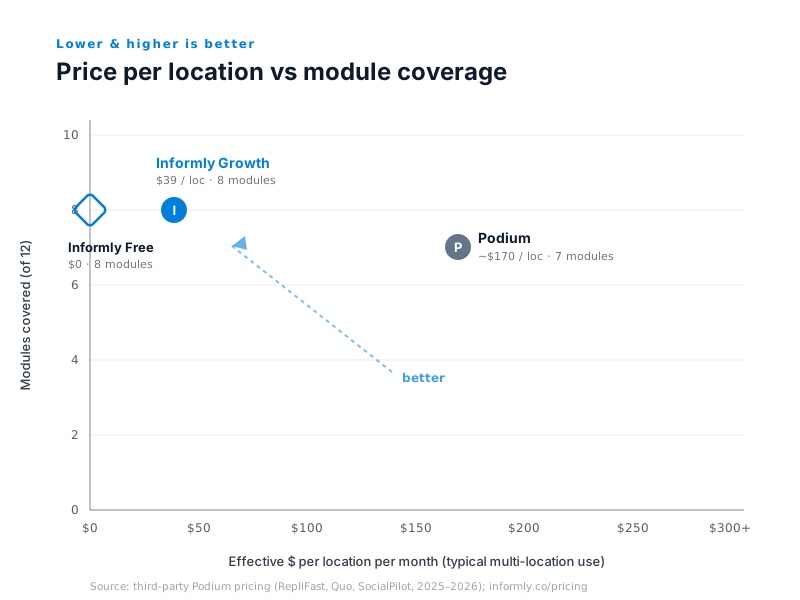
Per-location math. A 5-location restaurant group on Podium Pro pays $599/month before add-ons ($120/location). Add AI Employee and one VoIP user per location: roughly $850/month, plus setup — which lands at about $170/location/month, the figure plotted in the chart above. The same group on Informly Growth pays $195/month (5 × $39). The headline gap is about 3×. With Podium's add-ons fully stacked, it widens to 10× or more.
Three buying scenarios
These are the three operator profiles we hear from most. Read whichever matches your business.
Scenario 1: A 12-location restaurant chain prioritizing inbound guest messaging
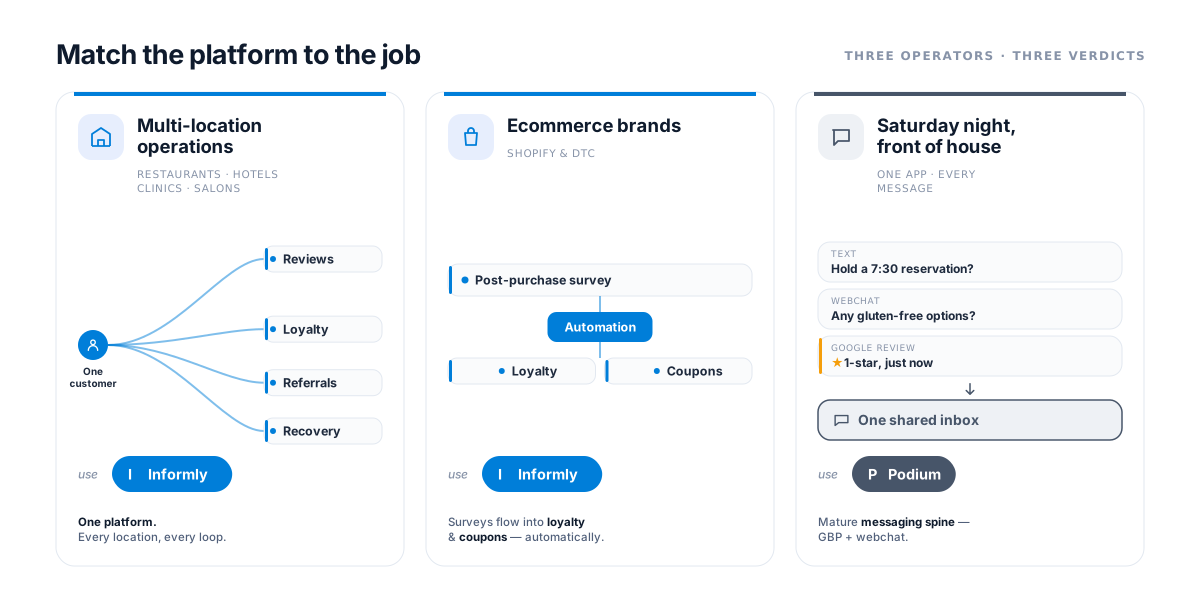
A guest texts to ask if you can hold a 7:30 reservation. Another asks about gluten-free options. A third leaves a one-star Google review on a Saturday night. Your front-of-house team wants one app to answer all three from the same inbox. Verdict: Podium. The messaging spine, the GBP integration, and the webchat are mature here, and the inbox UX is what front-desk staff want.
That said, consider Informly for restaurants bolted on for the survey-and-recovery layer. A post-visit NPS survey auto-creates a ticket for any score of 6 or lower. A recovery coupon goes to the detractor inside 24 hours. That's how you close the loop. Without it, you're answering the loud guest and missing the silent ones. 72% of customers share a positive experience with 6+ people (AmEx Customer Service Barometer, 2014, via Internet Archive), so the post-visit signal compounds in both directions.
Scenario 2: A Shopify ecommerce brand needing post-purchase NPS and automated referrals
The order ships. Seven days later, you ask for an NPS score. Promoters get an automated referral ask with a unique tracked link. Detractors get a recovery coupon and a ticket on the support queue. Verdict: Informly. Podium has no Referrals module, no Coupons module, and no native Shopify trigger for post-purchase. Zapier helps, but the customer record fragments across tools.
The referral math is what makes this lopsided. Referred customers convert at 4× the rate of other channels and spend 25% more on average than non-referred ones (Schmitt, Skiera, van den Bulte 2011, Wharton). If your post-purchase flow has no referral module, that's the revenue line you're leaving on the table.
Scenario 3: A multi-location salon group wanting loyalty, reviews, and recovery in one place
A client finishes a colour appointment. She gets a tap-to-respond feedback prompt. If she's a promoter, she gets a Google review ask and a stamp on her Apple Wallet loyalty card. If she's a detractor, the system can auto-create tickets from negative feedback and send a recovery coupon. This is the wedge Informly's salon and beauty setup is shaped for. Verdict: Informly. Podium has no loyalty product at all. Podium added a native Mindbody integration in 2025 (post-appointment review requests, class-signup notifications), but Booker still runs through Zapier, and neither covers the loyalty-stamp / referral-ask layer.
The loyalty effect is well-established: customers in active loyalty programs make 5× more repeat purchases (Smile.io 2025 loyalty stats, citing Sailthru, with Bain showing 30–60% higher purchase frequency as the directional anchor). Stacking that against the post-visit recovery loop, the salon scenario is where the platform pivot pays for itself fastest.
See it in your own setup: start free with Informly — all 7 modules on the free plan, no credit card, no setup call. Or book a 20-minute demo if multi-location is your wedge.
Is Informly a Podium alternative?
Yes, on the retention side. No, on the inbox side. Here's the honest version. Informly is a Podium alternative for surveys, loyalty, referrals, coupons, testimonials, and ticketing. Those are the five modules Podium doesn't ship at all (Loyalty, Coupons, Referrals, Testimonials, Ticketing) plus the one it ships only partially (Surveys: NPS/CSAT only, no branching). It is not a one-for-one replacement for Podium's webchat, unified social DM inbox, or VoIP phones. If you're shopping for "the texting app for the front desk," Informly isn't trying to be that. If you're shopping for "the platform that turns every signal into action," that's the Informly job.
Informly is a customer growth platform. Podium is a messaging and reviews tool. The categories overlap in the buyer's shortlist but solve different halves of the job.
Can I keep Podium for messaging and add Informly?
Yes. The bolt-on path:
- Keep Podium as the inbound inbox for the front desk.
- Run Informly for surveys, ticketing, loyalty, referrals, testimonials, and the cross-module customer record.
- Wire the two together via Twilio integration (Podium uses Twilio for SMS; Informly natively integrates with Twilio for outbound SMS) and webhooks. Informly's
webhookaction can post into Podium's API, and Podium's review events can fire Informly automations.
This isn't the "platform" pattern (you'll still have two customer records) but it's a pragmatic interim if the front desk's inbox workflow is genuinely critical to existing operations.
Why would I pick Podium over Informly?
Honest answer: three reasons.
- The inbox is the operational backbone. If 70% of your team's daily customer touches happen through inbound messages, Podium's threaded inbox is better-shaped than anything you'd build by stitching together Informly modules.
- You already take payments via text. Podium Payments is native; Informly doesn't replicate this pattern out of the box (Stripe via integration is possible but isn't the native flow).
- The category leader signal matters internally. If the buying committee includes a CFO who needs the comfort of a Series E vendor with tens of thousands of customers, that's a real consideration. Informly is earlier-stage and is honest about its founding-customers cohort instead.
None of those are reasons to write off Informly. They're reasons to be honest about which problem Podium solves best.
The bottom line
The Informly vs Podium choice is really a choice between two operator profiles. Podium is the right call when the inbox is the day. Informly is the right call when signals are the day.
Three sentences of self-honesty before you sign anything:
- "Most of our customer work happens inside replies to inbound messages." → Podium.
- "Most of our growth comes from acting on survey responses, visits, and post-purchase signals." → Informly.
- "Both." → Use Podium for the inbox, Informly for everything that fires from a signal. Bolt-on via Twilio + Webhooks.
The 96% of unhappy customers who never complain don't show up in any inbox. They show up as a missed second visit, a low NPS score, a quiet churn. If recovering that 96% is the core CX bet — automatically, within hours, across every module — Informly is the platform built for that bet.
Free plan • No credit card • Upgrade anytime.